
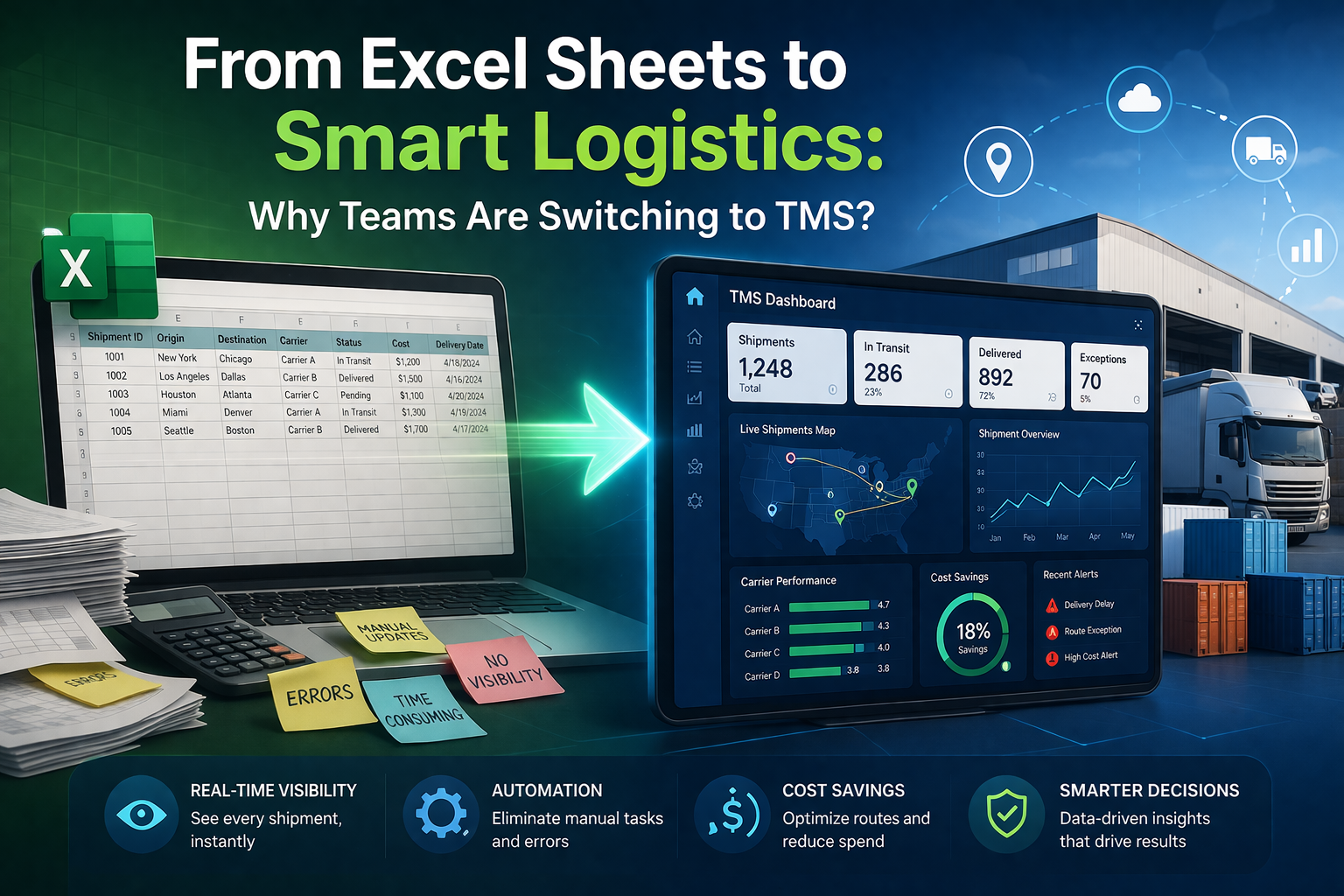
This is where smarter solutions come in. Companies are now turning to Xfrate, a trusted TMS service provider, to move beyond spreadsheets and build more efficient, connected logistics operations with a Transport Management System.
When spreadsheets begin to hold your business back?
In the beginning, spreadsheets can handle basic shipment tracking and scheduling. But as delivery volumes increase and operations expand, managing everything manually becomes overwhelming.
Teams often deal with repeated data entry, version mismatches, and inconsistent information across files. These issues create confusion and make it difficult to maintain accuracy. Over time, this leads to delayed workflows, reduced efficiency, and higher operational risk.
The lack of visibility that slows everything down
The biggest challenge with spreadsheets is not just manual work but the lack of real-time visibility. Teams often rely on outdated information, which slows decision-making and reduces responsiveness. By the time issues are identified, they have already impacted operations. A Transport Management System Solution solves this by providing live updates and centralised visibility, allowing teams to act quickly and maintain better control.
How does a Transportation Management System bring clarity and control?
A Transportation Management System brings all logistics activities into one platform. With Xfrate’s solution, businesses can plan routes, assign shipments, track deliveries, and manage billing from a single interface.
These advanced Transport management services simplify operations and remove the need for multiple disconnected tools. As a result, teams gain better control, improved accuracy, and more streamlined workflows.
Replacing manual effort with smart automation
One of the biggest advantages of adopting a TMS is automation. Tasks like scheduling shipments, updating delivery statuses, and generating reports can be handled automatically.
This reduces the chances of human error and speeds up daily operations. Teams no longer need to spend hours on repetitive work and can instead focus on higher-value tasks that drive growth.
Relationship basis and improper allocation- High cost
Often businesses land up spending much higher on freight due to lack of proper allocation methods. AI based freight planner , coupled with innovative allocation methods have proven to significantly cut freight costs.
Enabling faster and smarter decision-making
Real-time tracking and performance monitoring allow teams to respond quickly to changes. Whether it is a delay, route disruption, or urgent delivery update, decisions can be made instantly with accurate data.
For any growing Freight management company, this level of responsiveness improves reliability and helps maintain consistent service standards.
Scaling operations with confidence
As businesses grow, managing logistics through spreadsheets becomes increasingly difficult. A TMS provides the structure needed to scale without adding complexity.
It supports higher shipment volumes, handles complex logistics networks, and ensures consistency across operations. Instead of chaos, growth becomes more organised and manageable.
Improving customer experience
Customer expectations continue to rise. They expect timely deliveries, clear communication, and accurate updates. With real-time tracking and reliable ETAs, a TMS helps businesses deliver a more transparent and dependable experience. This strengthens customer relationships and builds long-term trust.
Driving cost efficiency and operational performance
Inefficiencies in manual systems often go unnoticed but have a direct impact on costs. Errors, delays, and poor planning increase operational expenses. A Transport Management System helps optimise processes, improve resource utilisation, and reduce unnecessary costs. This leads to better financial performance and stronger margins.
Why businesses are making the shift now?
Logistics is no longer just about moving goods. It is about managing speed, accuracy, and constant change. As operations become more demanding, traditional tools start to break under pressure. Businesses that want to stay competitive need more than basic systems. They need visibility, control, and the ability to make decisions in real time. That is why the shift toward smarter logistics systems is accelerating.
Conclusion
Spreadsheets may help you start, but they cannot support long-term growth. To scale efficiently, businesses need systems built for speed, visibility, and control. With Xfrate, companies can move from manual processes to a smarter, more connected approach powered by a Transport Management System.
If you are still relying on spreadsheets, it is worth asking how much they are limiting your growth. Discover how Xfrate can simplify your operations, improve visibility, and help you scale with confidence. Book a demo today.